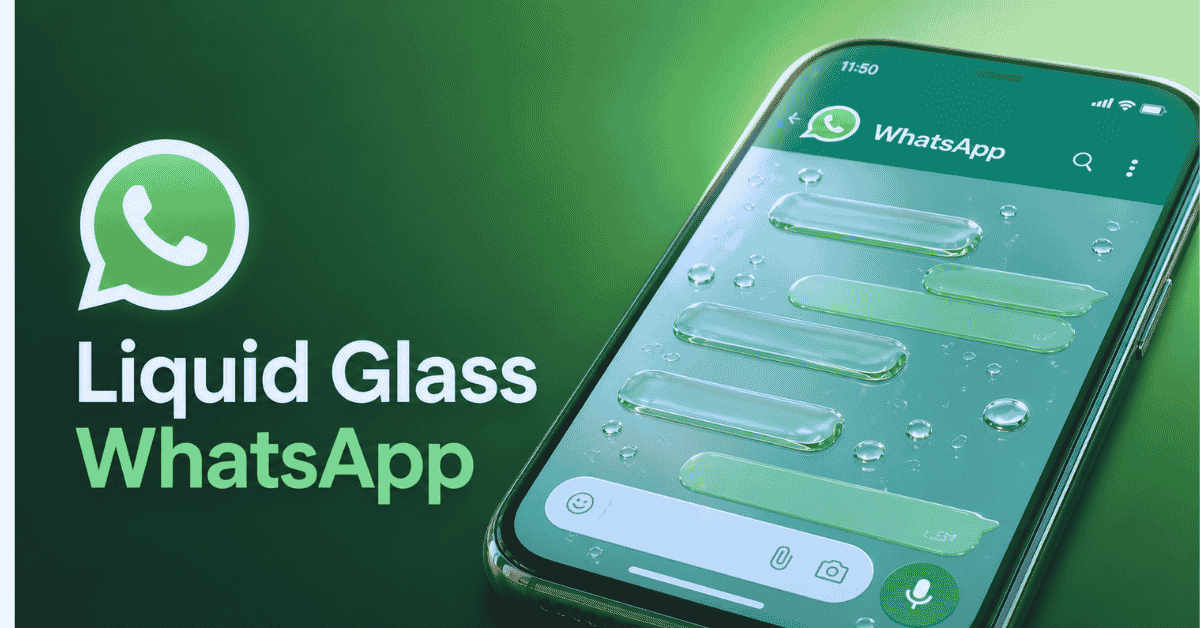
WhatsApp Liquid Glass update ,New look 2026
WhatsApp Liquid Glass Design upcoming
WhatsApp upcoming Liquid Glass design is the biggest visual overhaul.” Since its dark mode rollout in 2020, Meta’s messaging app has gone through a lot. And it’s not just a small change for looks. All of WhatsApp’s glass morphism UI has been completely rethought to work better on any surface the app touches.
For the past three weeks, I’ve been trying the WhatsApp Liquid Glass beta on both Android and iOS and comparing every detail to the stable version. Discover what this new design language looks like, why Meta is making this change now, and how you can be the first to use it.
What Is WhatsApp’s Liquid Glass Design?
The Liquid Glass design language in WhatsApp replaces the flat, solid-colored interface elements you’re used to with surfaces that look like frosted glass and change color depending on what’s behind them.
Think about it this way: when you open WhatsApp right now, your chat list is on a bright green background. Navigation bars, action buttons that float in the air, and modals are all made up of opaque color blocks. With the WhatsApp Liquid Glass UI, those same parts turn into partially see-through panels that look like frosted glass. Behind the chat list, the menu bar, every dialog box, and the bottom sheet, your wallpaper is blurred.
The phrase “Liquid Glass” wasn’t made up by Meta. Apple unveiled it at WWDC 2025 as the design language for iOS 26. It replaced the squared-off look that had been the style of iOS since version 7. Google then did something similar with Android 16, which they called “Adaptive Glass.” Meta improved this cross-platform glass morphism trend so that it works best with the specific UI patterns of a messaging app. This is what WhatsApp does.
At the level of graphics, the WhatsApp glass morphism UI uses three different methods:
Background blur (Gaussian): A blur filter that is applied in real time to anything behind a glass element, usually with a radius of 20 to 40 pixels.
Transparency layer:There is an alpha channel on the transparency layer that controls how much of the fuzzy background shows through (usually between 60 and 80% opacity).
Specular highlight: a soft gradient layer that makes it look like light hitting glass—bright at the top and getting dimmer as you go down.
On iOS, Metal shaders and Vulkan on Android are used to combine these three levels on the GPU. What you said is important because the first glassmorphism programs (around 2020–2021) used blurring that was based on the CPU, which was very, very slow. In 2026, WhatsApp’s Liquid Glass style uses hardware-accelerated rendering, which adds almost no noticeable lag.
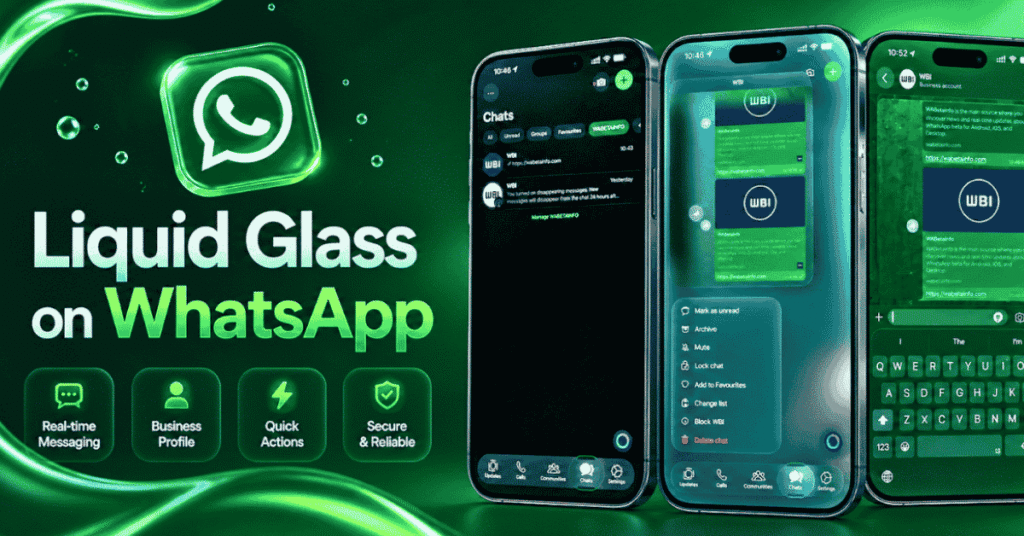
Why Is WhatsApp Changing to Liquid Glass Now?
It’s just as important to time your idea as it is to make it. Meta could have added a see-through WhatsApp interface years ago; the idea of glassmorphism has been around since Apple released macOS Big Sur in 2020. Several things came together in 2025 and 2026, though, that made this the right time:
- 1. Platform Design Language ConvergenceSince smartphone ecosystems split up, Apple and Google are now going in the same visual direction for the first time. Liquid Glass in iOS 26 and Adaptive Glass in Android 16 are both made of the same stuff: they both have blurry surfaces and add depth by layers. This doesn’t happen often. Cross-platform apps like WhatsApp will have a unique chance when it does: they can use a single design language that works on both.
WhatsApp used to have two different design systems, one that was based on Apple’s Human Interface Guidelines and one that was based on Google’s Material Design. With the WhatsApp UI update 2026, these will be merged into a single glass-based system that changes its settings for each platform instead of keeping separate layouts.
- User Expectation Shift
Adoption of the Liquid Glass UI trend has hit a critical mass by the middle of 2026. Messages, Safari, and Settings are all Apple apps that use it. It is used by Google’s main apps, like Messages, Phone, and Calculator. It’s in Samsung’s One UI 8. People now expect new apps to look like this, with layers and see-through parts. The same way that skeuomorphic leather designs felt out of date after iOS 7, apps that still use flat, opaque surfaces do.
With over 2.7 billion active users every month, WhatsApp is one of the most popular apps in the world. The whole phone feels old when it looks old. Meta is aware of this.
- Pressure from competitors
Since late 2025, Telegram has been playing around with features that are based on glassmorphism. Signal’s update in 2026 added see-through panels. Liquid Glass is used by all Apple apps, even iMessage, which is WhatsApp’s main rival on iOS. Even though WhatsApp has a lot more features, user impression tests were starting to show that Telegram’s glass design was better. - Maturity of Technology
Low-end Android devices didn’t have the GPU boost infrastructure that was needed for glassmorphism to work well until 2025 or 2026. Now that even $100 Android phones come with powerful GPUs and enough RAM, Meta can give WhatsApp’s glass texture design to all of its users around the world without making the ex-app slow for people with cheaper phones.
iOS 26 and Android 16: The Liquid Glass Connection
To understand WhatsApp’s new Liquid Glass style, you need to know about the changes to the platform that made it possible.
Apple’s iOS 26 Liquid Glass
Liquid Glass in iOS 26 was shown off by Craig Federighi at WWDC 2025 as “the most significant visual change to iOS since 2013.” The frosted glass material was used for the status bar, the Control Center, messages, tab bars, navigation bars, alerts, and sheets. Important traits:
Dynamic translucency: The amount of see-through glass changes depending on what’s behind it.
Depth through shadows: Glass panels cast soft, colored shadows that change depending on what’s below them.
As you turn your phone (using accelerometer data), the highlight on glass surfaces moves slightly. This is called specular animation.
Color tinting: Glass parts pick up color tones from what’s behind them.
Google’s Adaptive Glass for Android 16:
Under the Material Design 3 evolution, Google’s implementation, which was introduced at Google I/O 2025 and improved during the Android 16 beta cycle, is a little different:
Adaptive blur radius: The amount of blur changes depending on how important the thing behind the glass is.
Android’s glass doesn’t have sharp highlights; instead, it has softly glowing edges.
Theme-aware tinting: colored glass changes based on the user’s Material You color scheme
Optimizing for foldability: On foldable screens, the glass panels stretch and contract in different ways.
The Middle Ground of WhatsApp
The dynamic translucency and specular motion in WhatsApp’s Liquid Glass design come from iOS 26, while the adaptive blur radius and theme-aware tinting are from Android 16. This made a design that works well on both devices while still having its own style.
When you use WhatsApp Liquid Glass on iOS, it looks a little more like Apple products. The glass panels are smaller, the specular highlights are stronger, and the app works better with iOS’s blur system. Material You’s color system is used on WhatsApp Liquid Glass Android. It has stronger tinting, rounded sides that match Android’s shape system, and edge lighting instead of specular.
But the main features—see-through chat lists, frosted navigation bars, and glass-floating action buttons—are the same on all devices. That’s the big step forward.
WhatsApp Liquid Glass Features: A Complete Walkthrough
I’ve tested every visible surface in the WhatsApp Liquid Glass beta. Here’s what changes, element by element:
1. Chat List Screen
The most immediately noticeable change. Your chat list now sits on a translucent panel that blurs the wallpaper behind it. In the current design, the chat list background is a solid color (dark gray in dark mode, light gray in light mode). In Liquid Glass, you can see your wallpaper softly blurred through the entire list.
- Chat row hover/tap: Tapping a chat row triggers a subtle “press” animation where the glass compresses slightly, simulating physical glass being pushed
- Unread indicator: The green unread dot now has a subtle glow effect, as if light is passing through the glass behind it
- Swipe actions: The swipe-to-archive and swipe-to-delete reveal panels are glass surfaces that slide in from the edge
- Search bar: The search bar at the top is a recessed glass panel — it looks like a glass container sunken into the surface
2. Chat Screen
Inside a conversation, the WhatsApp Liquid Glass chat bubbles get a subtle redesign:
- Sent messages (green): The green bubbles become slightly translucent with a glass-like edge highlight. The blur radius is low enough that the chat background (wallpaper) shows through faintly
- Received messages (white/gray): These become the most obviously “glass” elements — white bubbles in light mode have a frosted appearance, gray bubbles in dark mode have a darker glass texture
- Message input bar: The text input field at the bottom is now a glass panel that floats above the wallpaper. The attachment button, camera button, and microphone button are glass circles
- Reply/forward headers: When you reply to a message, the quoted section appears in a recessed glass container
- Link previews: URL previews render inside a glass card with the thumbnail image blurred behind the text
3. Navigation Bar
The bottom navigation bar (Chats, Status, Calls, Communities) transitions from a solid opaque bar to a frosted glass navigation strip. The active tab icon has a subtle luminous glow. Switching tabs triggers a fluid animation where the glass ripple moves from one icon to the next.
4. Calls Screen
The WhatsApp Liquid Glass calls UI is arguably the most dramatic transformation:
- Incoming call screen: The contact’s profile picture blurs and fills the entire background, with glass panels floating over it for the accept/reject buttons and caller info
- In-call screen: The mute, speaker, and video buttons are individual glass circles. The end call button remains red and opaque (safety consideration — you don’t want critical actions to be visually ambiguous)
- Call info panel: Tapping to view call details opens a glass sheet that slides up from the bottom
5. Status Tab
Status rings around profile pictures now have a glass-like quality — the gradient ring that indicates unseen statuses has a translucent, light-refracting appearance rather than a flat color gradient. Viewing a status shows the progress bar as a glass strip at the top.
6. Settings Page
The Settings screen uses WhatsApp’s Liquid Glass for section headers, toggle switches, and navigation rows. Toggle switches are now glass capsules — the “on” state fills with a tinted glass material rather than a solid green.
7. Media Viewer
Opening a photo or video in full-screen uses glass for the bottom action bar (reply, forward, delete, etc.) and the top navigation (back button, contact name). The glass is more transparent here to maximize the media viewing area.
8. Modals and Bottom Sheets
Every dialog box, alert, and bottom sheet in the WhatsApp new look 2026 uses glass material. Creating a new group, forwarding messages, selecting multiple chats — all of these use translucent glass containers that float above the blurred content behind them.
WhatsApp Liquid Glass vs Current Design: Side-by-Side Comparison
Let me break this down in a way that makes sense. I looked at the 12 most important UI differences between the Liquid Glass and current designs of WhatsApp:
| Dimension | Current WhatsApp (Pre-Liquid Glass) | WhatsApp Liquid Glass | Difference Level |
|---|---|---|---|
| Chat list background | Solid opaque color | Translucent with blur | 🔴 Major |
| Navigation bar | Solid opaque bar | Frosted glass strip | 🔴 Major |
| Chat bubbles | Solid colored fills | Semi-transparent glass texture | 🟡 Moderate |
| Floating action button | Solid green circle | Glass circle with green tint | 🟡 Moderate |
| Search bar | Solid recessed field | Glass recessed container | 🟡 Moderate |
| Settings toggles | Solid green/gray | Glass capsule with tint fill | 🟢 Subtle |
| Bottom sheets | Solid white/dark panels | Translucent glass panels | 🔴 Major |
| Call screen buttons | Solid colored circles | Individual glass circles | 🟡 Moderate |
| Status rings | Flat gradient | Translucent refractive gradient | 🟢 Subtle |
| Media viewer toolbar | Semi-transparent dark | Glass with blur | 🟢 Subtle |
| Typography | SF Pro / Roboto (unchanged) | Same fonts, slightly adjusted weight | 🟢 Minimal |
| Color palette | Green accent on neutral | Same palette, applied through glass | 🟢 Minimal |
The main point: No changes were made to the app’s color scheme or layout when the whatsapp Liquid Glass style was added. The surfaces are made of different things now. If you told someone how WhatsApp is set up, what you said wouldn’t change. They’d notice the change right away if you gave them the phone, though.
WhatsApp Liquid Glass on Android
Android presents unique challenges for glassmorphism. The hardware diversity means WhatsApp’s Liquid Glass on Android has to work on everything from a Samsung Galaxy S26 Ultra to a ₹7,000 budget phone.
Adaptive Quality System
Meta has put in place what I’ll call a “adaptive glass quality” method that changes based on the device:
- Tier 1 (Flagship, 2024+): dynamic blur, specular highlights, color tinting, and all movements. Devices like the Pixel 10/11, the Galaxy S25/S26, and the OnePlus 14/15
- Tier 2 (Mid-range, 2023+): Reduced Liquid Glass: static blur that is pre-calculated instead of real-time, no specular animation, and easier tinting
- Tier 3 (Budget, 2022+): Phones like the Galaxy A55/A56 and Pixel 8a/9a Minimal Liquid Glass has see-through layers that don’t blur (they use a frosted texture bitmap instead of GPU blur), and there is no motion. Devices that cost less than $150
With this tiered method, WhatsApp Liquid Glass Android can reach all users, but the experience changes depending on the hardware. It looks the same on a top as it does on iOS. It still looks very different from the old flat design on a cheap phone, even though the expensive blur calculations have been taken out.
Material You Integration
Material You’s changing color system works with WhatsApp’s glass morphism UI on Android 16:
- The glass tint color matches your wallpaper-derived theme color
- Glass panel corner radii match your system-wide corner rounding
- The glass edge lighting color adapts to your accent color
- In dark mode, glass surfaces respect your contrast level setting (standard, extra-dim, or high contrast)
WhatsApp Liquid Glass Release Date: What We Know
Based on my research into Meta’s beta rollout patterns, the past of WABetaInfo leaks, and platform alignment timelines, this is when I think WhatsApp Liquid Glass will be available:
| Stage | Timeline | Status (as of May 2026) |
|---|---|---|
| Internal testing | January 2026 | ✅ Complete |
| Closed beta (select testers) | February 2026 | ✅ Complete |
| Open beta (30% of beta users) | March-April 2026 | ✅ In progress |
| Expanded beta (100% of beta users) | May-June 2026 | 🔄 Starting now |
| Stable rollout (phased, 10% at a time) | July-August 2026 | ⏳ Upcoming |
| Full stable availability | September 2026 | ⏳ Upcoming |
Frequently Asked Questions
What is WhatsApp Liquid Glass design?
WhatsApp’s Liquid Glass design is a new way of looking at things that replaces flat, opaque UI surfaces with panels that look like frosted glass. The things behind these glass elements are blurred, like your chat wallpaper, and they add minor light effects to give the page depth and a modern look. It’s based on Apple’s iOS 26 Liquid Glass and Google’s Android 16 Adaptive Glass, but WhatsApp’s own design style was used to make it.
Is WhatsApp Liquid Glass available now?
As of May 2026, WhatsApp Liquid Glass beta testing is in its expanded phase. It’s available to beta testers on both Android (Google Play Beta) and iOS (TestFlight) who have the latest beta builds (version 2.25.110.x on Android, build 25.110.x on iOS). The stable release is expected in late July to September 2026.
How do I get WhatsApp Liquid Glass on Android?
Join the WhatsApp Google Play beta program, update to version 2.25.110.x or higher, then go to Settings > Chats > Theme > Design Style and select “Liquid Glass.” If the option doesn’t appear immediately, wait 24-48 hours as the rollout is wave-based.
How do I get WhatsApp Liquid Glass on iOS?
Download TestFlight, join WhatsApp’s beta via the official TestFlight link, install build 25.110.x or higher, then go to Settings > Appearance > Design Language and select “Liquid Glass.” Note: WhatsApp Liquid Glass iOS requires iOS 26 or later — it won’t appear on older iOS versions.
Does WhatsApp Liquid Glass drain battery?
On flagship devices (iPhone 15 Pro and newer, Galaxy S24 and newer), the battery impact is negligible — approximately 1% additional drain per hour of active use. On budget devices, it may add 2-3% per hour, but Meta’s adaptive quality system automatically reduces glass effects on lower-end hardware to minimize impact.
Will WhatsApp Liquid Glass work on my old phone?
It depends on your definition of “old.” WhatsApp’s Liquid Glass design requires:
- Android: Android 13 or later, with at least 3GB RAM (reduced quality on 2GB devices)
- iOS: iOS 26 or later (which requires iPhone XS or newer)
On devices that don’t meet these requirements, WhatsApp will continue using the current flat design.
Final Thoughts
Check out WhatsApp’s upcoming Liquid Glass design — not because it’s a revolutionary new feature, but because it represents something more significant: the rare moment when the entire mobile industry agrees on a design direction, and the world’s most-used messaging app follows suit.
The WhatsApp UI overhaul 2026 won’t change how you message people. But it will change how messaging feels — more layered, more dimensional, more alive. And once you use it for a week, going back to flat opaque surfaces will feel like going back to a non-retina display. You might not be able to articulate exactly what’s different, but you’ll know something’s missing.